
At Stepping Stones Early Learning Centre, we believe that every child is naturally curious and capable of learning in extraordinary ways. One of the educational philosophies that inspires our approach to early childhood education is the Reggio Emilia approach.
Developed in the town of Reggio Emilia in Italy after the Second World War, this philosophy was founded on the belief that children are active participants in their own learning. Rather than simply receiving information, children explore, investigate, and discover the world around them through meaningful experiences.
Children as Capable Learners
The Reggio Emilia approach views children as competent, curious, and full of potential. From an early age, children observe their surroundings, ask questions, and try to understand how things work.
At Stepping Stones, educators support this natural curiosity by creating environments where children are encouraged to explore ideas, experiment with materials, and express their thoughts in creative ways.
Rather than directing every activity, educators act as guides and collaborators, helping children expand their thinking and deepen their understanding.
Learning Through Interests and Projects
One of the key elements of the Reggio Emilia approach is project-based learning. Children’s interests often become the starting point for learning experiences.
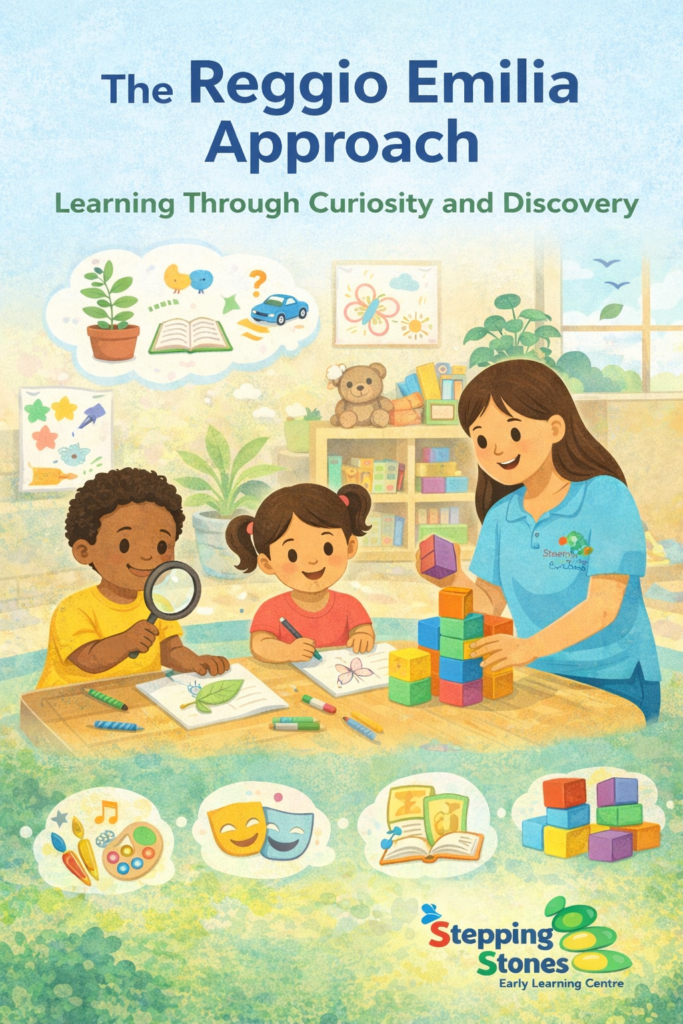
For example, if children show curiosity about animals, plants, or nature, educators may build activities and discussions around those interests. Through drawing, storytelling, conversation, and exploration, children begin to investigate the topic more deeply.
These projects encourage children to ask questions, share ideas, and develop problem-solving skills.
The “Hundred Languages of Children”
Reggio Emilia educators believe that children have many different ways of expressing themselves — sometimes referred to as the “hundred languages of children.”
Children communicate their ideas not only through words, but also through:
- art and drawing
- music and movement
- dramatic play and storytelling
- construction and creative building
- sensory exploration
By encouraging these different forms of expression, children are able to share their thoughts and creativity in ways that feel natural to them.
The Learning Environment
In the Reggio Emilia philosophy, the learning environment is often described as the “third teacher.”
At Stepping Stones, our classrooms are thoughtfully arranged to encourage exploration, creativity, and collaboration. Materials are accessible, spaces are inviting, and children are encouraged to interact with their surroundings.
A well-prepared environment helps children feel confident in exploring and discovering new ideas.
Partnership With Families
Another important aspect of the Reggio Emilia approach is the strong partnership between educators and families.
Parents are seen as an important part of the learning community. At Stepping Stones, we believe that parents are a child’s first and most important teachers, and we work closely with families to support each child’s development.
Through communication, observations, and shared experiences, we ensure that parents remain connected to their child’s learning journey.
Supporting Lifelong Learning
The Reggio Emilia approach encourages children to think independently, ask questions, and explore the world with confidence.
By nurturing curiosity and creativity during the early years, children begin developing the skills and mindset needed for lifelong learning.
At Stepping Stones Early Learning Centre, we are proud to incorporate elements of this philosophy into our daily practices, creating an environment where children feel inspired to discover, learn, and grow.